AI Task Crossover for Solo Creators and Product Demo Videos
Task crossover lets a solo creator borrow the thinking of a strategist, producer, editor, and analyst. Use this four-role sprint to make clearer product demo videos without turning every step into a new generation.
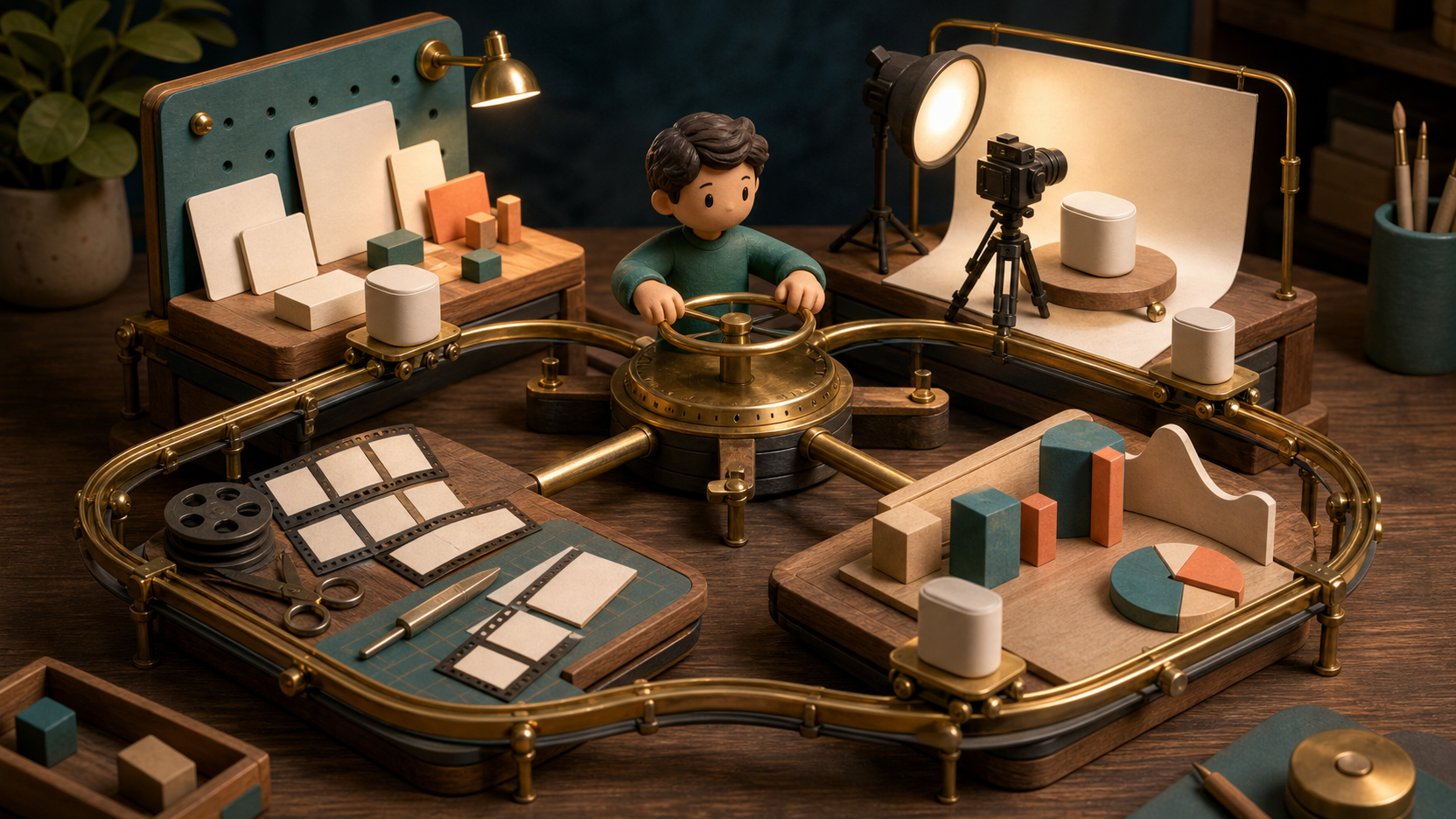
A solo creator rarely has a solo job. A thirty-second product demo can require positioning, scripting, art direction, shot planning, editing, and distribution analysis before it is ready to publish. That is why a new OpenAI Economic Research finding matters to creators. In an analysis of more than 800,000 work-related ChatGPT messages, 43.5% of occupation-specific messages involved tasks associated with another occupation. The report calls this pattern task crossover. People are not only doing familiar work faster. They are taking on useful pieces of jobs that once required a handoff. For a creator, task crossover does not mean pretending to be four specialists at once. It means borrowing a specialist's questions at the right moment. The practical result is a better product demo brief, fewer vague generations, and a clearer reason to keep or reject each clip. Here is a four-role sprint you can run on one product video.
Start with one proof, not one big idea
Choose the single thing the viewer should believe after watching. A good demo proves an action or outcome that can be seen. It does not merely show a beautiful object. Weak proof: "This bottle is premium." Useful proof: "The lid opens with one hand and does not leak when the bottle is turned over." Write four fixed constraints before asking for help:
- Viewer: Who needs this proof?
- Action: What should they do next?
- Evidence: What must be visible on screen?
- Format: Where will the video run, and how long can it be? For example: a commuter should see that the lid opens one-handed, then click to view the product page. The evidence is a close shot of the thumb opening the lid, followed by an upside-down leak test. The output is a vertical clip lasting twelve seconds. These facts become the boundary for every role that follows.
Role one: borrow a strategist's focus
A strategist turns a product feature into a claim that matters to a specific viewer. Ask for options, but force each option to use the same evidence. This prevents the conversation from drifting into slogans that the footage cannot prove.
Act as a product positioning strategist.
Audience: commuters carrying a drink in one hand.
Visible evidence: one-thumb lid opening and an upside-down leak test.
Format: a 12-second vertical product demo.
Give me three distinct hooks. Each hook must be provable by the visible evidence.
Do not invent materials, test results, certifications, or product features.
Pick a hook with a simple test: could a silent viewer understand the claim from the first two shots? If not, revise the hook before generating video. The strategist pass is complete when you have one sentence that connects viewer, problem, and visible proof. Do not ask it for a full campaign yet.
Role two: borrow a producer's shot discipline
A producer converts the claim into shootable units. For AI video, the key is to limit what changes inside each shot. A clip that asks for a new camera angle, a hand interaction, a liquid simulation, and a background transformation at once gives you too many failure points. Use this prompt to create a bounded shot list:
Act as a product video producer.
Turn this proof into four shots for a 12-second vertical video.
Proof: the lid opens with one thumb and stays sealed upside down.
For each shot, give duration, framing, one subject action, camera behavior, and continuity constraints.
Keep the bottle color, lid shape, hand, lighting direction, and tabletop consistent.
Use no text overlays and no scene transformation.
Review the answer with three production questions:
- Can each shot be judged on one main action?
- Can the hard continuity details be repeated in every prompt?
- Does each expensive shot add new evidence? If two shots prove the same thing, remove one. If a shot only adds atmosphere, consider making it a still image with a short camera move instead of a full text-to-video generation. In Quby Video Studio, build the first pass from the minimum proof sequence. Save style experiments for a second version after the actions work.
Role three: borrow an editor's rejection criteria
The editor's job is not to rescue every output. It is to decide what deserves a place in the cut. Set the rejection rules before viewing results, when you are less likely to excuse an attractive mistake. Score every shot from zero to two on five criteria:
| Criterion | 0 | 1 | 2 |
|---|---|---|---|
| Proof | Missing | Partly visible | Immediately clear |
| Product identity | Changed | Small drift | Consistent |
| Motion | Broken | Usable with trim | Natural |
| Continuity | Distracting mismatch | Minor mismatch | Matches sequence |
| Edit value | No useful moment | One usable beat | Clean start and end |
| A shot must score two on proof and product identity. A high total cannot compensate for a changed lid or an invisible action. This rule stops visual polish from hiding a failed demo. | |||
| Use a diagnostic prompt only after you write your own notes: |
Act as a strict product video editor.
My notes for this take are: the thumb action is clear, the lid changes shape at 2.1 seconds, and the final frame has a useful pause.
Classify the take as keep, trim, or regenerate.
Name the exact usable time span and give one targeted prompt correction.
Do not rewrite the full concept.
Quby is useful at this stage as a shared place to compare takes, trim the usable beat, and keep the winning shot near its prompt. The important habit is to change one cause at a time. If the lid drifts, strengthen the identity constraint without also changing the lens, lighting, and action.
Role four: borrow an analyst's experiment design
A distribution analyst asks which variable a new version is testing. Random variations feel productive but teach you very little. Build two versions after the proof sequence passes:
- Hook test: same shots and timing, different opening frame.
- Pacing test: same hook and shots, different trim lengths. Do not change the hook, pacing, music, crop, and call to action in one version. If it performs better, you will not know why. Define the result before publishing. For a twelve-second demo, you might watch the percentage of viewers who reach the leak test, clicks to the product page, and comments that mention the one-handed opening. Choose one primary signal. The others help explain it. A useful analysis prompt is:
Act as a content experiment analyst.
Control: product close-up opens the video.
Variant: thumb action opens the video.
Everything else is unchanged.
Primary signal: percentage of viewers reaching second 6.
List three possible outcomes, what each would suggest, and the next single-variable test.
Do not claim causation from a small sample.
Decide which tasks should cross over
Not every task belongs in the AI-assisted part of the sprint. Use three questions before borrowing a role:
- Is the output reversible? Generating three hook options is easy to undo. Publishing an unsupported claim is not.
- Can you inspect it? A four-shot plan is visible and testable. A vague instruction to "make it better" is not.
- Is the boundary clear? Asking for a targeted continuity fix is bounded. Asking for final creative judgment is not. Keep product truth, taste, permissions, and the final publishing decision with a person. Borrow AI for option generation, structure, checklists, and targeted diagnosis. That split lets you cross role boundaries without giving up authorship.
Run the sprint in one hour
For a small demo, timebox the process:
- 10 minutes to define the visible proof and fixed constraints.
- 10 minutes to select one strategist hook.
- 15 minutes to create and check the producer shot list.
- 15 minutes to generate or assemble the minimum proof sequence.
- 10 minutes to score takes and define one distribution test. If the sequence fails, return to the earliest broken decision. A confusing action is a production problem. A clear action that does not support the claim is a strategy problem. A correct shot hidden by a slow opening is an edit problem. This diagnosis is more useful than adding detail to every prompt. If you want to try the sprint on your next product idea, open Quby Video Studio and start with the two shots that prove the claim before building the rest of the campaign. Task crossover works when it removes unnecessary handoffs while preserving clear decisions. You are still the creator. You simply have a better set of professional questions available at each stage.
Ready to Create with AI?
Put these techniques into practice with Quby's professional AI creative tools.
Launch Creative Suite